The Ayurvedic Doshas: Vata, Pitta, and Kapha
The system of Ayurveda (ayur = life, veda = knowledge, “the science of life”) developed in India over 5,000 years ago and is rooted in the Vedas, making it possibly the oldest continuously practiced tradition of healing. Ayurveda and Yoga are considered sister sciences, in that they arise from the same philosophical lineage and are both technologies for cultivating health, balance, and self-knowledge.
At its core, Ayurveda reflects universal laws of nature. It recognizes that the human body possesses an inherent intelligence that is constantly seeking balance, and its philosophy centers around preserving and promoting health and longevity as well as self-healing through restoring balance when disease arises. Living in a way that cooperates with these natural forces is the brilliance of Ayurveda. Life finds a way, and we are her stewards.
Health encompasses our various dimensions—physical, psychological, social, and spiritual well-being. And while Ayurveda can take a lifetime to master, learning some fundamental concepts and implementing simple lifestyle changes can have a dramatic positive effect on both physical and mental health.
Five Elements, Three Doshas
Ayurveda understands the universe—and the human body—as expressions of five elements: earth, water, fire, air, and space. These elements combine into three organizing principles, or biological energies, known as doshas: Vata (air+space), Pitta (fire+water), and Kapha (earth+water).
Each person is born with a unique constitutional blend of these three doshas, called their prakriti. This constitutional makeup remains stable throughout life (Take the Quiz: Discover your dominant Dosha). From an Ayurvedic standpoint, disease most often arises when an excess one or more dosha arises due to diet, lifestyle, emotional patterns, environment, or season. Ayurveda offers a way to recognize these imbalances and gently guide the system back toward equilibrium, in relation to one’s individual constitution.
Vata is composed of air and space, Pitta of fire and water, and Kapha of earth and water. Their qualities mirror the elements themselves. Vata governs movement, like the wind. Pitta governs digestion and metabolism, consuming like a fire. Kapha provides structure and lubrication, like soil and clay.
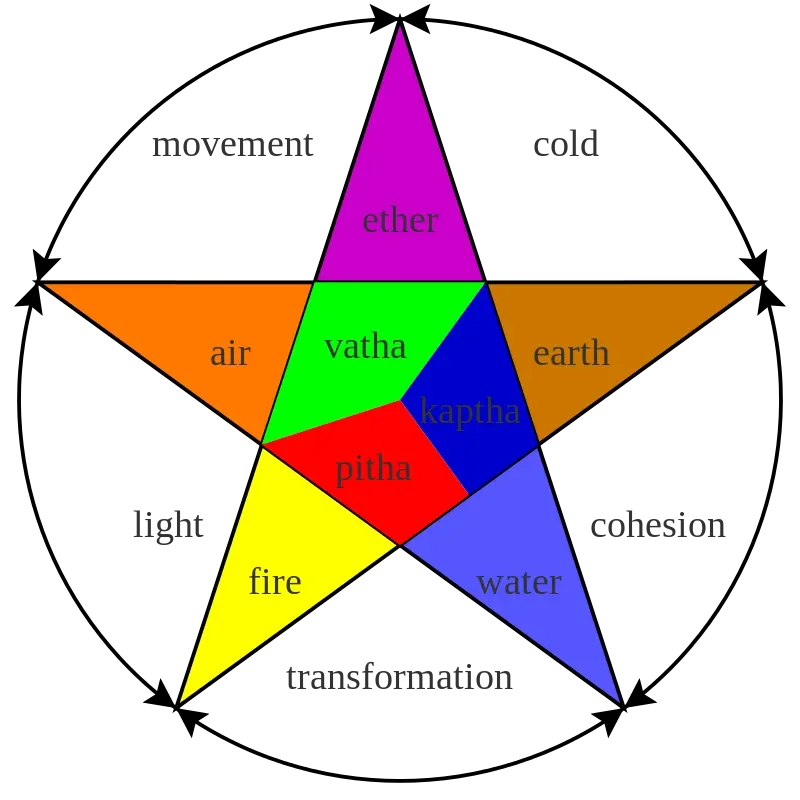
from wikipedia
Unlike modern Western medicine, which relies primarily on quantitative measurements such as lab values, Ayurveda is largely qualitative. Cold or hot, Dry or oily, heavy or light. Each dosha presents itself through certain physical qualities, or gunas, within your body. This is why an Ayurvedic assessment might include attention to things like the appearance of your tongue, skin, body frame, sleep, and even prominent emotions.
Rather than treating the symptoms, Ayurveda seeks to understand the underlying imbalance that gave rise to it. Two people with the same set of bothersome issues may receive very different treatments based on the nature of the imbalance.
The Three Doshas
Pitta, like fire, is hot, light, sharp and oily (oil burns). Pitta is responsible for digestion and appetite, body temperature, and the color and luster of the skin, eyes, and hair. Psychologically, it is associated with intelligence, reasoning, ambition, and courage.
People with a Pitta-dominant constitution often have strong digestion, moderate and muscular builds, and tend to run warm and sweat easily. When balanced, Pitta confers clarity and leadership. How does Pitta get aggravated? By things that increase its presence in the body: heat, spicy or oily foods, excessive sun exposure, and hot emotions like irritability or competitiveness. Out of balance Pitta can look like someone easily enraged, and who experiences inflammatory conditions like heartburn, acne, high blood pressure, and inflammatory arthritis.
Vata, like the wind, is cold, dry, light, rough, mobile, and irregular. It governs all movement in the body, including breathing, circulation, nerve impulses, and the movement of thoughts. Creativity, enthusiasm, and adaptability are hallmarks of balanced Vata.
Vata-dominant individuals often have slender frames, lighter bones, dry skin, cold hands and feet, and variable digestion. They may be sensitive to cold and prone to irregular appetite and sleep. When Vata becomes excessive, the mind races, which looks like anxiety, fear, scattered thinking, and nervous system disorders. Physical symptoms of too much Vata include constipation, stiffness, spasms, or chronic pain. Irregular schedules, excessive stimulation, cold foods, overexertion, and worry all tend to aggravate Vata.
Kapha, made of earth and water, is heavy, slow, cool, dense, soft, and oily. It provides structure, lubrication, immunity, and emotional steadiness. In balance, Kapha expresses as groundedness, strength, patience, contentment, and compassion.
Kapha-dominant people often have sturdy builds, smooth skin, strong endurance, and calm temperaments. When Kapha accumulates in excess, it can lead to lethargy, overattachment, depression, and resistance to change. Physically, excess Kapha can manifest as congestion, excess mucus, weight gain, and metabolic sluggishness. Kapha is aggravated by inactivity, overeating, heavy or cold foods, and excessive sleep, especially during the day.
Rhythms of Life
Each dosha also has rhythms tied to time of day and season.
The fiery Pitta is strongest during, you guessed it, summer! Guard against excess by avoiding excess heat (spicy foods, alcohol, fried foods, too much sun), incorporating cooling foods & herbs like cucumbers, melons, and mint, and emphasizing gentle movement and calming routines.
Air-like Vata, being cold and dry, is dominant in fall and winter. Consume warm cooked foods: soups, stews, root veggies, and oats, with warming spices: ginger, cinnamon, cumin, cardamom. Ground vata’s irregular quality with consistent meals and sleep. And stay well-oiled! Ayurveda recommends the practice of a daily self-massage with oil (abhyanga), eating ghee and other healthy fats, and lubricating the sinuses with oil. Videos for further instruction on self-oiling.
And the cold, heavy, Kapha peaks in spring, making spring’s keywords “lighten, dry, and stimulate”. Light, simple meals of bitter greens, legumes, barley, and steamed veggies, with stimulating spices such as black pepper, ginger, mustard seed, and turmeric. Favor more vigorous movement and reduce heaviness in the diet, limiting dairy, sweets, and fried foods.
These rhythms influence our experiences and may highlight flare-ups of imbalances, not just seasonally but also daily. For example, pitta-induced hot flashes or inflammatory insomnia may wake a person between 1 and 3am, whereas Kapha-related depression or heaviness may make getting out of bed in the morning especially difficult. Vata-related arthritis or worrying often worsens in the evening. These patterns act as warning signals, inviting us to study and align ourselves with the natural tides of life.
Making the Universal Personal
In the same way knowing your family history can help you anticipate and reduce health risks, understanding your constitution can help you recognize subtle forms of disharmony before they manifest as illness. A basic understanding of the doshas allows for small, practical shifts that gradually cultivate a healthier and more resilient body and mind.
As you can see, Ayurveda works from the framework that our body and mind are not distinct, but are intimately related. Modern science is learning of the importance of stress on health and the connection between our gut and brain. Ayurveda’s principles are equally applicable for balancing the mind and promoting mental health. Just managing a dosha imbalance through physical changes impacts the dosha’s corresponding emotional and mental manifestations.
Our environments matter too, from homes to our communities. Ayurveda recognizes that our surroundings influence our mental and physical health, a principle echoed in China’s feng shui. Time in nature (just two hours a week leads to better physical, mental, and emotional health), light, colors, scent, and flow in a space all influence how how we feel. A Vata constitution benefits from regularity and warmth (warming colors, scents, etc). Kapha benefits from stimulation and warm, bright colors. Pitta benefits from cooler colors and more softness.
Ayurveda offers an invitation into self-study. It encourages us to see ourselves not as isolated machines that can run on nutrient shakes in our own cubicles, but as living systems that are one with nature, in constant relationship with the natural world—the seasons, plants, animals, the planet, and the cosmos. It offers a framework for curiosity, experimentation, and care. Besides, what better place is there to explore the interplay of nature’s elements than within our own bodies? Ayurveda reminds us that nature is a worthy teacher—if we take the time to listen.
To your doshalicious life!
Luke
Footnote: Many of these ideas will sound familiar to readers steeped in Western traditions of medicine. Hippocrates, often considered the founder of modern medicine, echoed similar principles: “Let food be thy medicine and medicine be thy food.” “It is more important to know what sort of person has a disease than to know what sort of disease a person has.” “Natural forces within us are the true healers of disease.” “Everything in excess is opposed to nature.” “Wherever the art of medicine is loved, there is also a love of humanity.”
